

Tawny Crazy Ants: A Growing Problem in Southeast Florida
Tawny crazy ants (also known as Caribbean crazy ants) are one of the most disruptive and invasive pest species that is currently spreading slowly across Florida. Many residents confuse them for fire ants, but they’re a different species entirely. While they don’t bite like fire ants do, they still cause major infestations and big problems for homeowners and businesses in Florida alike. One of the biggest issues in dealing with them is that they cannot be completely eliminated with store-bought products or treatments.
This blog post will explain what makes these particular ants in Florida different, why infestations from tawny crazy ants persist over time, and why professional Integrated Pest Management (IPM) techniques are almost always required to properly remove them.
What Are Tawny Crazy Ants and Why Are They So Hard to Control?
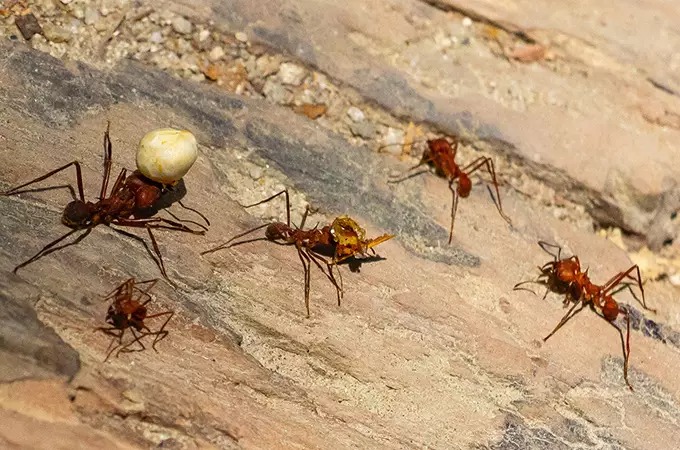
Tawny crazy ants are a species of ants that are originally native to South America. In recent years they have begun appearing in warmer southern states, including Florida. They get their name from their reddish-brown color (tawny) and their erratic movements (crazy).
They’re a small to medium sized type of ant that lives in large, interconnected colonies with multiple queens. They don’t create large dirt mounds or dig extensively underground like many other ant species do. Rather, they tend to create colonies by nesting in shallow dirt, underneath mulch piles, or along walls or even within electrical equipment. Because there are multiple colonies with multiple queens, they are very difficult to fully eradicate. Incomplete attempts at removal almost inevitably result in rebounded populations. These ants don’t bite like fire ants do, but they have a similar level of invasiveness and can quickly overwhelm structures, including homes and businesses.
Why DIY Pest Control Fails Against Tawny Crazy Ants
Your typical aerosols and chemical sprays can kill visible ants, but they ultimately do little to nothing that impacts the overall colony structure. As mentioned earlier, these ants live in independent but interconnected colonies with multiple queens. If one part of the mega-colony dies off, the population “buds” off and rebounds somewhere else, slowly making the problem worse. In addition, bait-based solutions fail because tawny crazy ants rapidly shift food preferences. Their overall hardiness as a species is one reason Florida homeowners who have dealt with them before might tell you that “nothing works” when it comes to dealing with them. But that’s not entirely true, as we’ll see.
What The Science Says: University of Florida & Expert Research
Properly removing tawny crazy ant populations ultimately requires a multi-pronged strategy called Integrated Pest Management (IPM) and one grounded in community involvement and coordination. According to the University of Florida’s Institute for Food & Agricultural Sciences (UF/IFAS),
Management of this pest will most likely require the services of a professional pest control company that practices IPM.
Additionally, these ants don’t understand or recognize property lines and boundaries. Due to their size and how they shift and spread over time, tawny crazy ants are, according to UF/IFAS:
…an area-wide problem, not an individual lot problem. The reduction of a tawny crazy ant population on one lot does not guarantee that the ants will not reinvade from adjacent areas. Tawny crazy ants affect entire communities, and can be controlled better if tackled as a community problem with simultaneous control measures over large areas.
This ant species is also particularly resilient and adaptive, with built-in “social immunity” behaviors according to very recent research published in late 2025 by UT Austin and the British Ecological Society, among others. Even when individual ants are poisoned or can threaten the core of colonies, they are quickly cut-off from the rest of the ant population, particularly the newborn larvae. This social segregation confers yet another adaptive mechanism for this particularly hard-to-eradicate ant species. As we’ll learn, longer-term, multi-pronged approaches with community-wide coordination are the most effective and recommended.
Why Integrated Pest Management Is Essential
Integrated Pest Management is a strategic and multi-step approach to pests that combines monitoring, habitat modification, targeted treatments, and ongoing follow-ups and inspections. For tawny crazy ants in particular, it typically might involve:
- Identifying multiple nesting zones
- Using non-repellant treatments
- Rotating bait strategies
- Long term population suppression
Unlike other pests, which can often be handled with one-off treatments with perhaps a single follow-up visit, IPM for tawny crazy ants is an ongoing and sustained plan, with multiple follow-ups to control populations.
Why Professional Ant Control Makes the Difference
Professional pest control companies have access to treatments and the knowledge of multi-pronged strategies that are not available to consumers. When it comes to dealing with this invasive species, experience truly matters. Knowing how, when and where to treat them can determine overall success and effectiveness. Here at Nozzle Nolen, our pest control plans feature Integrated Pest Management (IPM) based techniques and methods. We offer professional residential ant control services that southeast Florida homeowners can rely on.
Permanent Control Requires Smarter Strategies
Tawny crazy ants are an invasive and particularly resilient pest that is slowly spreading across Florida. IPM based professional treatments at the community level are the most effective approach in dealing with them. If you see or suspect signs of tawny crazy ant populations in or around your home, be sure to schedule an inspection or consultation before the problem gets any worse.