


Learn quick facts about Termite Swarmers vs Flying Ants and how to tell them apart in our video:
Why Florida Homeowners Panic When They See “Flying Bugs”
In southeast Florida, winged insects are fairly common sights around windows, patios, porches and porch lights, and lanais. Many homeowners often assume that these winged insects are the familiar “swarmer” termites that can appear seasonally every year. However, termite swarmers are often confused with and mistaken for flying ants, a completely different species.
While termite swarmers can be a genuine cause for concern, often signaling a nearby termite colony, the flying ants are way less of a nuisance and problem for the home. In this blog post, we’ll give you some quick and helpful identification tips for telling these two similar looking bugs apart.
Quick Question and Answer: Are Flying Ants Termites?
The quick answer is that no, flying ants are not termites, although they are often confused for one another. Both termites and flying ants are known to seasonally swarm, and their appearances are similar enough for them to get mixed up by Florida residents. It’s important to not identify termites on the basis of color alone, as many termites are dark in color. The University of Florida explains how the termite swarmer caste (also called “alates”) differ from flying ants.
Termite Swarmers vs Flying Ants: Quick Visual Checklists
The three body parts that will most easily distinguish between flying ants and termite swarmers are their antennae, waist, and wings. The shapes, sizes and visual details of these body parts will let Florida residents tell one from the other.
Antennae Details:
- Termite swarmers have straight antennae shapes
- Flying ants have bent or “elbowed” antennae shapes
Waist Details:
- Termite swarmers have a broader waist, with no visible “pinch” point
- Flying ants have a narrower waist with a “pinch” point
Wing Details:
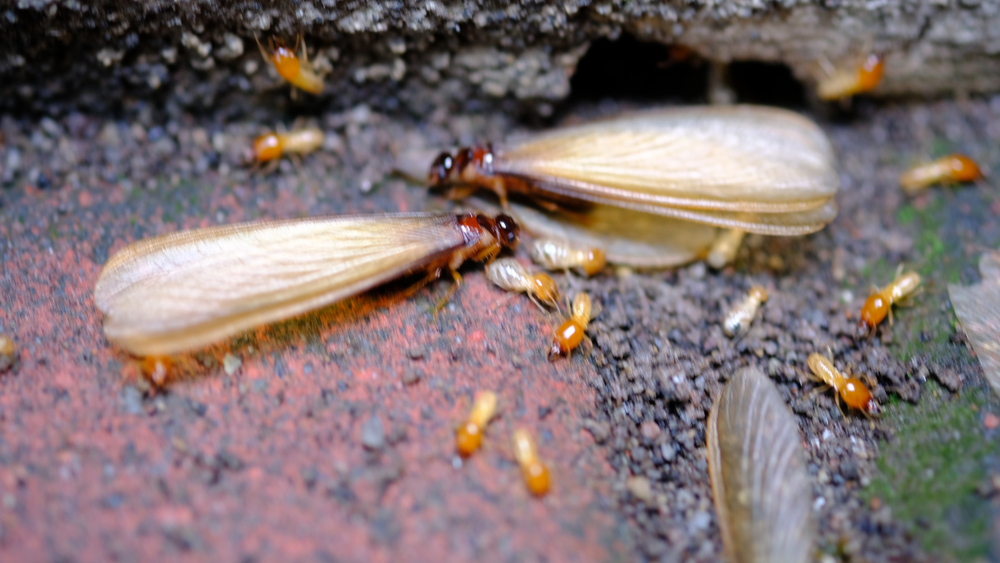
- Termites have four wings of roughly equal size that are often longer than the full termite body. Termite wings are often shed and can often be found collected on windowsills.
- Flying ants have a pair of front wings that are longer than the pair of back wings. Ant wings are shed or found in piles far less commonly than termites.
This helpful article from the University of Florida details some of the key visual differences between termites and flying ants. You can also review this simple ant vs termite checklist provided by the Mississippi State University Extension.
What Do Termite Swarmers Look Like In Florida?
As a refresher, there are 3 main types, or “castes” of termites. There are worker, soldier, and reproductive termite castes. Swarmers, or alates, are the reproductive caste for subterranean termites. They most commonly present visually with:
- A darker brown to black colored body
- Equal length wings
- A slower flight pattern
Alates swarm seasonally, usually in early spring through early summer, from as early as February through as late as May. Subterranean termites live in colonies underground, and the swarmer termites come aboveground for mating purposes and will often swarm on the outside of homes. Seeing them outside is not in and of itself an immediate cause for concern, but seeing them indoors is usually more worrisome.
Why Do Flying Termites Suddenly Appear?
Swarming behaviors are triggered by seasonal climate and weather conditions, including rainfall, humidity and warmth. When the cooler, dryer winter period starts to end and spring starts to begin, the higher temperatures and moisture levels cause the alates to leave the underground colony and begin mating behaviors. The swarmer termites are attracted to both light and warmth, so they will very often swarm and collect in large numbers on the outside of structures, including residential homes. You can learn more about termites in a prior blog post, including why they can be a year-round problem.
Red Flag Situations: When To Take Termite Swarmers More Seriously
As mentioned before, seeing termite swarmers outside is not always an immediate cause for concern and only indicates that there is an underground termite colony somewhere in the nearby area. However, if Florida residents begin to spot swarmer termites inside their homes, that’s usually a more pressing concern. Some other common “red flags” to look out for include:
- Piles of wings on windowsills
- Swarmers found in bathrooms or kitchens
- Swarmers spotted near baseboards
- Repeated, multiple swarms in the same spot, year after year
One or more of these red flags could suggest that the termite colony isn’t just in the general area, but directly next to the home or even within it. The more red flags observed together would suggest a higher and higher likelihood of an actual termite infestation on the homeowner’s property.
South Florida Reality Checks: ‘Super Termites” and Other Local Examples
Termites are one of the most destructive insect species on the planet for human societies, with annual global damages caused by them estimated to range in the tens of billions of dollars. In Florida alone, the estimated yearly damage runs up to hundreds of millions of dollars. A recent Tom’s Guide article highlighted newer kinds of “super termites” that can eat more than just wood. Locally, even historic Florida buildings require treatments when termites are detected. Due to their ongoing impact, Florida officials in the Department of Agriculture and Consumer Services actively track reports of Formosan termite swarms, which you view in this Florida termite surveillance map.
Why Termites Spread So Easily In Florida: Boats, Lumber, and Travel
There’s a few different reasons that termites can spread so easily in Florida specifically. For starters, the temperatures don’t dip low enough consistently to eradicate colonies. The subtropical climate in Florida is ideal for ongoing termite activity year after year. Secondly, termites can travel on building materials, particularly wood. The ongoing building development and increased building density in Florida over the last few decades has provided termites with ample food sources and opportunities to “hitchhike” to new locations. Finally, Florida is a coastal state, with lots of maritime activity. A recent University of Florida study found that boats are actually a very common mechanism for termite spreading and that termites are frequent “stowaways” on boats that are traveling in and around Florida waters.
What To Do If You Think You Found Termite Swarmers
If you suspect you’ve spotted actual termite swarmers – and not flying ants – there are a few helpful and straightforward steps you can take:
- Don’t immediately panic, but don’t ignore the sighting either.
- Try and save a specimen in a ziploc bag for a better ID later
- Take close-up photos of wings, waist and antennae shapes.
- Take wider angle photos of where the insects swarmed and appeared
- Avoid spraying chemicals that could interfere with future inspections or treatments
- Contact a professional company and schedule an inspection
Residents in Palm Beach county and surrounding counties can turn to Nozzle Nolen for reliable termite inspection and protection options for their south Florida homes. You can visit our website or watch our Termite Control commercial on YouTube for our contact information.
If It’s Really Termite Swarmers, Time Matters
As we’ve covered, not every flying insect that swarms outside is a termite, and flying ants in particular are often confused with swarmer termites. However, if you’ve indeed spotted swarmer termites, then you might have a more serious concern at hand. The sooner that you get an actual inspection from a professional pest control company, the cheaper and easier any needed remediation will be.
If you suspect you’ve had genuine termite alate activity around your home, you can visit the Nozzle Nolen website to schedule a free termite inspection and consultation today.